by HEC Team | Apr 6, 2017 | 2017, News
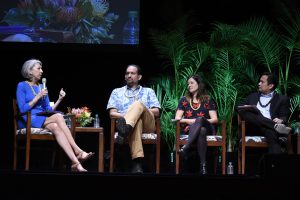
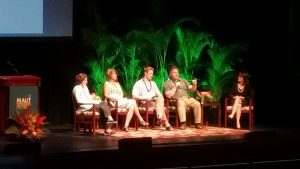
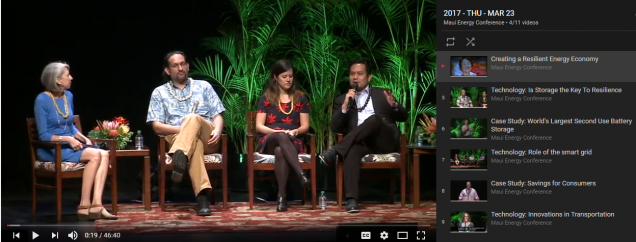
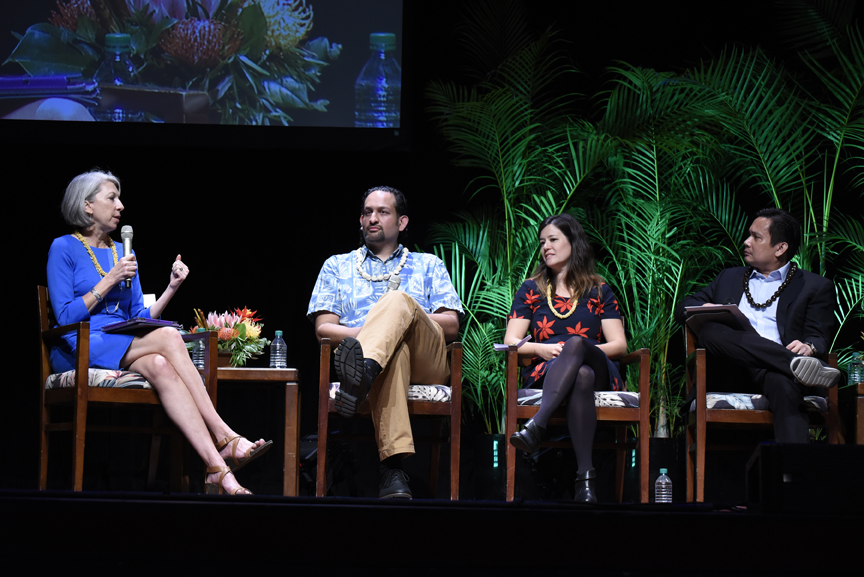
Creating a Resilient Energy Economy Panel L to R Cheryl Roberto, Kush Patel, Aki Marceau and Moderator Luis Salaveria of DBEDT.
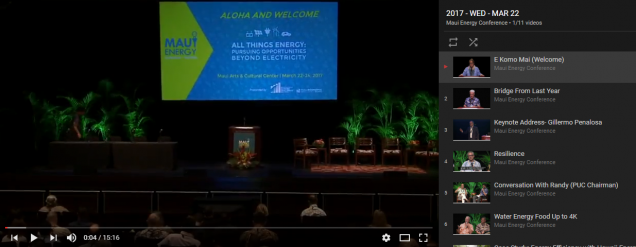
The fourth annual Maui Energy Conference, held March 22-24, 2017 at the Maui Arts & Cultural Center, broadened its focus this year to become a timely and innovative forum as the state continues its transition to a 100-percent clean-energy system by 2045. The conference theme, All Things Energy: Pursuing Opportunities for Electricity and Beyond, explored resilient and sustainable pathways that require the participation of all sectors. The program included keynote speakers, a session featuring case studies, and an exhibition hall to view various products and services, with ample networking time.
Hosted by the Mayor’s Office of Economic Development and Maui Economic Development Board (MEDB), the conference focused was on the human impact of the decisions we make to create a renewable, clean energy system that is strong but adaptable.
“Energy regulators and others need to communicate new decisions to the public in terms the average person can understand,” said Hawaii Public Utilities Commission Chairman Randy Iwase. “It’s not just making those tough choices that matters, it’s also explaining to the public why they were made.”
Record-Breaking Attendance
380 attendees, including utility executives, clean energy advocates, urban planners, transportation specialists, renewable energy providers, state and local government officials, and national and international experts in several fields, participated in discussions about Hawaii’s energy future. Mercedes-Benz, one of several international companies, reviewed its battery storage project in Germany to improve the environmental footprint of electric vehicles and make e-mobility more cost efficient.
The challenge of achieving decarbonized energy production and maintaining an energy system that is reliable, safe, affordable, secure, and resilient, is formidable. Resilience, this year’s conference buzz word, suggests toughness and the ability to bounce back from catastrophic circumstances. Since the last energy conference, Hawaii has seen a failed merger of electric utilities and several near misses from hurricanes, therefore resilience and sustainability formed the framework for discussing the challenges faced by utilities and the other energy stakeholders.
“The Maui Energy Conference ventured out into new territory this year, looking beyond the challenges of electricity and the grid to investigate transportation and other uses of energy that affect our pocketbook and quality of life,” said Frank De Rego Jr., Director of Business Development projects at MEDB and member of the conference Program Committee. “The keynote, by Guillermo Penalosa, founder and Chair of the Board, 8 80 Cities, set the tone and all the sessions explored how the resilience of our energy systems impacts our lives. An important take-away from the conference is the critical function of urban design and planning as Maui County moves forward to create prosperous and healthy communities.”
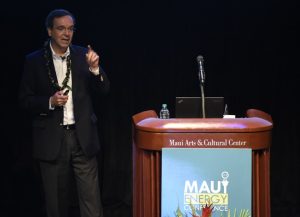
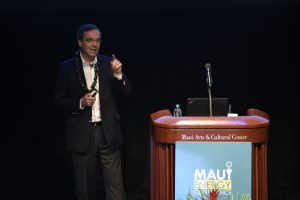
Keynote Speaker Gil Penalosa
Penalosa launched the event with his talk on Creating Vibrant, Healthy, and Resilient Communities for All. “If you create a great city for an 8 year old and an 80 year old, you will create a successful city for all people.” he said. His innovative concept involves the use of more parks and sustainable mobility: walking, riding bicycles, and public transit.
“We seem to be facing a perfect storm of threats and challenges, but in every challenge lies opportunity,” Penalosa noted.
“How we plan, build and cultivate a healthy city life for people of all ages, abilities, and socio-economic backgrounds have never been more important than it is today. As Hawaii pursues efforts to reduce its carbon footprint in the electricity and transportation sectors there are opportunities to build healthier, happier communities.”
Panel’s Discuss the Future for Energy
A panel discussion on Emerging Trends in Hawaii Energy Policy offered a look into Maui County’s current situation. Maui Mayor Alan M. Arakawa noted that last year’s study, the Guernsey Report, suggested the county should work with a private company to take over the electric grid from Maui Electric.
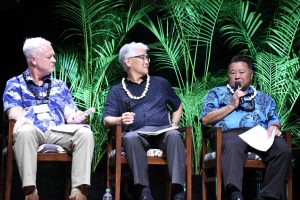
Mayor Alan Arakawa discusses the Emerging Trends in Hawaii Energy Policy with Alan Oshima, Hawaii Electric Company and Doug McLeod, Conference Program Committee Chair.
“The study did its job and certainly made an impact on the industry,” said the Mayor. “We’re definitely still looking at alternatives. It was never about replacing MECO, it was about what can be most beneficial to the county. We’re still looking at different changes to the grid system and different types of energies. At the same time, the county has seen the electric company working with the community and exploring ways the community can generate their own electricity.”
Brian Kealoha, Hawaii Energy Executive Director said, “We’re excited to continue the dialogue about our state’s 100-percent clean-energy goal, including all the elements that need to be put into place in order to make that a reality. It’s important for stakeholders who set policy to be able to have these conversations, hear different ideas and strategies that may be available to us from around the globe, as well as learn from other working models. These discussions will help us make smarter energy decisions and focus on what we need to do as a state to accomplish our objectives.”
Hawaii Energy’s case study highlighted a few of their success stories that showcase their commitment to helping small businesses lower operating costs through energy efficiency. “Small businesses are the backbone of Hawaii’s economic vitality and resilience,” Kealoha said. “Through programs developed specifically for them, Hawaii Energy has already helped over 400 Maui County businesses become energy efficient before moving on to photovoltaics and energy storage.”
“Our energy future has to be viewed through the lens of security and resilience,” agreed Scott Seu, Senior Vice President, Public Affairs, Hawaiian Electric Company. “A secure and resilient nation is one with the capabilities required across the whole community to prevent, protect against, mitigate, respond to, and recover from the threats and hazards that pose the greatest risk.”
Shayna Decker, Director, Communications Maui Electric, observed, “As we continue to make progress toward our state’s clean energy goals, we recognize that changing the way we operate is essential. We also know that it will take everyone working together. The Maui Energy Conference provides the opportunity to network, learn and partner with other entities who share our vision — government leaders, businesses, community members and organizations, and environmental groups — to secure a clean-energy future for Hawaii.”
Decker added, “This year, the conference discussions went beyond electric energy and highlighted how energy, food, water, and transportation are intertwined. This presents all of us with tremendous opportunities to find solutions together to move us forward.”
About 50 speakers presented, debated and discussed the broad resilience theme over the three days. “Urban design dictates lifestyle, and lifestyle has a huge impact on people’s energy footprint,” said Jonathan Koehn, Conference Program Committee member and Regional Sustainability Coordinator of the City of Boulder. “There are so many ways that physical infrastructure around us influences our energy choices.”
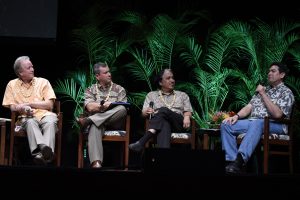
The Panel discusses the Water Energy Food Security Nexus L to R – Jeffrey Pearson, Rick Volner, Kyle Data and Paul Brewbaker
Koehn moderated a panel discussion featuring Paul Brewbaker of TZ Economics, Kyle Datta of Ulupono Initiative, Jeffrey Pearson of the state Commission on Water Resource Management and Rick Volner, General Manager of diversified agriculture for A&B. The panel explored the nexus between agricultural production, water use, and energy production.
Volner said, “With the successful closure of sugar operations in 2016, A&B is currently implementing diversified agricultural and renewable-energy opportunities on the former sugarcane land. For example, we are looking at raising cattle and working with local farmers, besides developing renewable-energy projects.”
Kyle Datta of Ulupono Initiative said, “Hawaii is just beginning a critical conversation about the role of water in energy resiliency and sustainability. When sugar was cultivated, agriculture used the majority of surface water on Maui. We mined our groundwater reserves to meet our needs.”
“Our current course is unsustainable,” Datta noted. “We supply very little local food but 26 percent renewable energy with marginal business models from a prior century. What is the cost-benefit of reinvesting in watersheds?” he asked.
Theodore Peck, Executive Officer and Lead Developer of Holu Energy, presented two case studies of commercial on-grid microgrids operational in Hawaii with third-party ownership, integrating photovoltaics and energy storage systems to create multiple value streams on both sides of the meter.
“The days of reviewing a single utility bill are over,” Peck said. “A fully integrated distributed energy resource ecosystem provides value to all stakeholders. Synchronization is the game-changer in energy technology.”
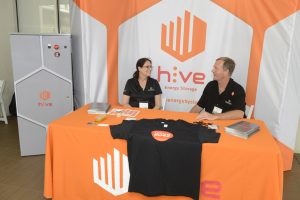
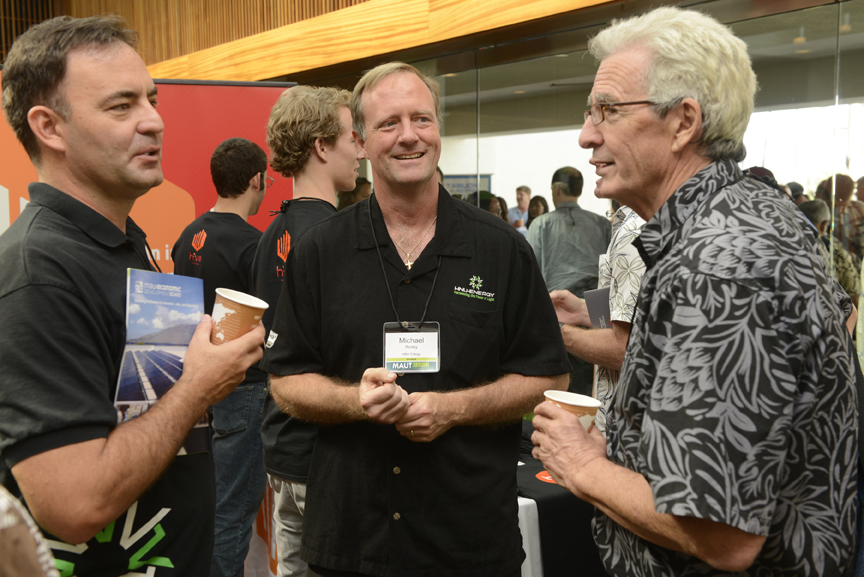
Terawatt Sponsor HNU Energy launched HiVE energy storage at the 2017 Maui Energy Conference
Various panels investigated the strategies required to secure reliable, safe and affordable energy as an entire system. Resilience was also the thread that wove together various dimensions of the discussion when nuclear energy as a ‘clean’ energy source was discussed.
“Whatever your objective is, the argument that nuclear energy is more friendly to the environment is being made across the US,” explained Program Committee Chair Doug McLeod. “We wanted our audience to be familiar with the arguments being made at the national level, and then add a layer of Hawaii-specific information related to our constitutional provision.”
“Building nuclear plants is a tough task anywhere in the US,” said Gavin Bade, Associate Editor, Utility Dive and moderator of the panel on Emerging Trends in Nuclear Energy Policy.
“However, Hawaii’s constitutional limitations and public sentiment against the technology make the task an even tougher one in the Aloha State,” Bade said. “This year’s expert panelists agreed that if nuclear ever is to come to the state, it will likely be in the form of small modular reactors of less than 50 megawatts. While these technologies are currently in development, panelists concurred they are at least a decade from commercialization. As such, there is likely not a role for nuclear on the islands for at least the next ten years.”
A Shift in Energy
An invited presentation by featured speaker Michelle Wyman, Executive Director, National Council for Science and Environment (NCSE), set the tone for the discussion on day two of the conference.
“This year marks a shift in the political landscape that presents opportunities and challenges at all levels of government,” said Wyman. “The energy sector, already rife with change, can benefit significantly from the strength that science provides.”
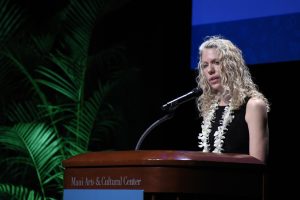
Michelle Wyman, National Council for Science and Environment
Wyman discussed the alignments between energy, science and policy, and offered insights into pursuing those. “We are living in a world of turbulent change, chaotic and unpredictable,” she explained. “Still, we are resilient by design. We need to use our environmental and scientific knowledge to make our decisions in the gateway to resilience, which is the capacity to adapt to changing conditions and impacts such as intense storms, droughts, and wildfires. Resilient design is a response to our vulnerabilities. Communities need to adapt and survive. This is why we need a new business paradigm.”
Another draw for this year’s Conference was Carol Sim, Director of Environmental Affairs, Alaska Airlines. Sim has been instrumental in developing Alaska Air’s formal sustainability program and establishing emission reduction goals, including use of a new sustainable, alternative jet fuel made from forest residuals. Sim joined the panel discussion on Innovations in Transportation, which looked at what steps can be taken to create and facilitate a resilient transportation sector.
“Commercial aviation accounts for less than two percent of the carbon dioxide emissions in the US and only about two percent globally,” said Sim. “While that percentage may seem low, aviation emissions are highly visible and are projected to increase with industry growth. Our project managed Alaska Airline’s 75 biofuel flights in 2011 and 2016, and has adopted other aggressive goals for reducing greenhouse emissions.”
Cheryl Roberto of Twenty First Century Utilities, an investment utility firm in Washington DC, was part of a panel of experts asked what they thought the energy industry might look like in 25 years. “Utilities have been the backbone of energy transformation and will continue to be, but their role is evolving,” Roberto said. “They won’t be the sole provider anymore. Instead there will be a platform for integrating all the energy services out there as a market innovator.”
The Energy Conference concluded with a Sustainability Workshop hosted by MEDB, Maui Brewing Company, and the Maui High Performance Computing Center (MHPCC) in Kihei. Maui’s energy challenges have triggered creative solutions in business, military operations, and education.
The 2017 Maui Energy Conference provided several threads that may be explored in future conferences as stakeholders from our local community, the nation, and the world will once again meet on the Island of Maui to help shape new solutions to the many energy challenges we face.
by HEC Team | Mar 8, 2017 | 2017, News
The fourth Maui Energy Conference is just two weeks away and promises to be a showcase of energy innovation. Hosted by the Mayor’s Office of Economic Development and the Maui Economic Development Board (MEDB), this year’s conference is big, going by the numbers.
With the State of Hawaii recognized as a pioneer in the new energy economy and regulatory landscape, over 350 delegates are expected to attend the 2017 Maui Energy Conference at the Maui Arts and Cultural Center. Utilities of all stripes, regulators, ISOs, consumer advocates, urban planners, transportation specialists, renewable energy providers, clean energy activists, state and local government officials and others will find value in Hawaii’s experience and the knowledge and experience of a variety of local, national and international experts.
“The conference provides ample time for networking to dive deeper into challenges, insights, new technologies, and unique perspectives emerging from the sessions,” said Frank De Rego Jr., Director of Business Development Projects at MEDB and member of the conference Program Committee.
50 Speakers will present, debate and discuss the broad theme, “All Things Energy” over two days. Guillermo (Gil) Penalosa of 8 80 Cities headlines the event with his talk on “Creating vibrant, healthy, and resilient communities for all.” We seem to be facing a “perfect storm” of threats and challenges, but in every challenge lies opportunity. How we plan, build and cultivate a healthy city life for people of all ages, abilities, and socio-economic backgrounds has never been more important than it is today. Drawing on his experience working with over 250 cities across 6 continents, Gil provides a holistic approach to tackling key urban challenges by focusing on both bold but doable actions any community can take to become stronger and more resilient in the face of change.
Michelle Wyman, Executive Director of the National Council for Science and Environment will kickstart the Conference on Day 2. The former Director of the US Department of Energy will present “The Resilience of Scientific Integrity during Uncertain Times,” exploring the intersects and alignments between energy, science and policy, and offer insights into pursuing those.
Joining a number of speakers from Hawaii, will be speakers from Colorado, Washington State, California as well as Japan.
There will be 10 panel sessions with a focus on resilience. The conference will investigate the strategies required to secure reliable, safe and affordable energy as an entire system. Resilience will be the thread that weaves together various dimensions of our discussion as we visit the place of nuclear energy as a “clean” energy source; the role of electrification in transportation; the importance of land use planning with its relation to energy production and consumption; the place of biofuels and biomass in our energy mix; technological innovations in energy storage and grid stability; the water, agriculture, and energy security nexus and much more.
“I think it represents our most ambitious Program yet,” said Jeanne Skog, President of Maui Economic Development Board. “The Program Committee did a remarkable job.”
5 Case Studies will inform the audience of new technology and other methods to meet sustainability goals. Case studies will be presented by Hawaii Energy (Energy Efficiency); Holu Energy (Energy Storage); Mercedes Benz (World’s Largest Second Use Battery Storage); Silver Spring Networks (Savings for Consumers derived from AMI & Smart Grid Connectivity); and Alaska Air will share how they track sustainability.
20 Exhibitors will be showcasing their energy products and innovations in Morgado Hall.
On Friday, March 24, there will be a Sustainability Workshop with a tour of the Maui Brewing Company and the Maui High Performance Computing Center.
TERAwatt Sponsor HNU Energy will unveil its new HIVE battery storage solution. GIGAwatt sponsors are Silver Spring Networks, Hitachi, Ulupono Initiative and Maui County.
The full list of sponsors is: Alaska Airlines, County of Maui, Hawaiian Electric Companies, Hawaii Energy/Leidos, Hawaii Gas, Hawaii Natural Energy Institute, Hawaii State Energy Office, Hitachi, HNU Energy, Holu Energy, HTDC, Itron, Kauai Island Utility Cooperative, Mercedes-Benz Energy, More Than Smart, Pacific Biodiesel, PVH Energy Storage, Sempra Renewables, Silver Spring Networks, Ulupono Initiative.
For details of program and registration please visit www.mauienergyconference.com
by HEC Team | Mar 2, 2017 | 2017, News
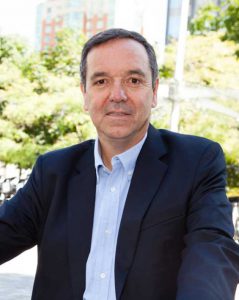 Gil Penalosa, Founder and Chair of 8 80 Cities, headlines the 2017 Maui Energy Conference with his keynote on The 8 80 City: Creating vibrant, healthy, and resilient communities for all.
The world urban population will double from 3.5 billion to 7.0 billion in the next 35 years. The cities we build today will be where billions of people will live for many hundreds of years. This represents a once in a lifetime opportunity to support the development of healthy, sustainable, and inclusive cities.
Amidst the challenges of population growth and shifting demographics, cities around the world are also grappling with climate change, rising obesity, traffic congestion, and a sluggish economy.
We seem to be facing a “perfect storm” of threats and challenges, but in every challenge lies opportunity. How we plan, build and cultivate a healthy city life for people of all ages, abilities, and socio-economic backgrounds has never been more important than it is today.
How can we improve the quality of life for people in cities regardless of age or social status? What is the role of sustainable mobility in promoting health, happiness, and stronger local economies? Gil answers these questions while also explaining a simple and effective principle for inclusive city building: ensuring the safety and joy of children and older adults (from 8 year olds to 80 year olds) are at the forefront of every decision we make in our cities.
Drawing on his experience working with over 250 cities across 6 continents, Gil provides a holistic approach to tackling key urban challenges by focusing on both bold but doable actions any community can take to become stronger and more resilient in the face of change.
Click here for more information on the complete 2017 program.